Tuesday, November 26, 2013

Some Not Very Interesting News

Well, I'm pretty sure that by now everyone I know is pretty tired of hearing about the website, so that's why the title of this post is "Not Very Interesting News." But, I have been working my ass off and I have to have some place to post updates of what's new... so here it is.

My friend Daniel and I were talking about meditation, and I was kind of psyched about all the Transcendental Meditation content I had uploaded earlier, so I got to work and made the Meditation landing page. I totally love how it looks. The ads need some tweaking so they aren't so... well... obnoxious... but other than that I really like it. I also put up some meditation content:
Then I posted two more Sufi Stories.
I also added two new pages (A story called "Socks", and 4 new poems) to the Independent Review Winter 1986 issue. I figure if I do one or two pages at a time, it'll eventually be completely finished and I can move on to the Spring 1987 Issue, and at some point all the issues will be online and I'll be done with that.

Then I got excited about creating the Dog Training Pages which I think looks awesome. I also uploaded a few pages of stuff including:
So, there you have it. The story of my weekend...

Sunday, September 28, 2008

The Truth About Brutus

1118


The K9 Above is Brutus, a military K9 at McChord. He's huge - part Boxer and part British Bull Mastiff and tops the scales at 200 lbs. His handler took the picture. Brutus is running toward me because he knows I have some Milk Bone treats, so he's slobbering away! I had to duck around a tree just before he got to me in case he couldn't stop, but he did.

Brutus won the Congressional Medal of Honor last year from his tour in Iraq . His handler and four other soldiers were taken hostage by insurgents. Brutus and his handler communicate by sign language and he gave Brutus the signal that meant 'go away but come back and find me'. The Iraqis paid no attention to Brutus. He came back later and quietly tore the throat out of one guard at one door and another guard at another door. He then jumped against one of the doors repeatedly (the guys were being held in an old warehouse) until it opened. He went in and untied his handler and they all escaped. He's the first K9 to receive this honor.

If he knows you're ok, he's a big old lug and wants to sit in your lap. Enjoys the company of cats.


So that's the story that came with the picture. And I like that story! Too bad it isn't true. Here's the real story:

The dog's name is not Brutus; in fact, his name is 'Spike," and he was never a military working dog. Spike is a retired Police Service Dog who served honorably during the years 2001 to 2007 with the Scottsdale Police Department's K-9 Unit in Scottsdale, Arizona, under his handler, Officer Scott DiIullo (who is still with the K-9 Unit and working with a new K-9 partner).

Spike is a Belgian Malinois imported from Europe and weighs less than 100 pounds. Furthermore, police and military working dogs are NOT trained to fatally attack a subject they are deployed upon. Dogs used for handler protection are trained to bite and hold the subject until the subject is taken into custody. There is also no training method to teach a working dog to understand a hand signal to command the dog to leave the area, come back later, and then attack.

Thursday, September 18, 2008

A Dalmatian On A Tricycle

That’s right, it is exactly what the title post indicates, a dalmatian operating a tricycle. How fun is that?

Wednesday, September 17, 2008

Update on my dog Cinnamin

My little dog is doing so much better - it's almost unbelievable. When she got sick - which was on Aug 23, she was dehydrated, disoriented, wobbly, weak, refusing food or water, and if you looked at her sideways she was likely to fall down.

Today she went for a swim in the pond, rolled on the grass to dry off, trecked into some pretty high grass trying to sniff out a rabbit, barked at and almost chased the sheep (she couldn't work up to an actual run), ate almost 2 cups of food, and didn't fall down once. We have been spending hours outside, walking around probably a total of 7 or 8 times a day.

I don't have the money to have her re-xrayed to see if the cancer is in remission, and I don't know if she is "cured" or just feeling good. I can tell you that she does not look at all like a sick dog. Yes, you can tell that she's elderly - she is 14 years old - and her knees do bother her some (two knee replacements), so there is a bit of stiffness - but all in all - she looks pretty darn good.

So, to what do I attribute her remarkable recovery? Here is a listing of her "treatment" program:

  • Reiki - pretty much all day long
  • Genesis Tuning Fork - I had to cut back on it because it really knocked her out when I used it, so I'm down to every 4 or 5 days or so. When I use it, I run it over her about 5 or 6 times. That thing is powerful!!
  • Radionics - I have a friend who does this cool thing using a piece of her hair. The day he started up on her I noticed a significant improvement in her energy level. I had never heard of it before, and it really does seem to work.
  • Angels and Devas - I have asked for assistance from her guardian angels, and the overlighting Deva of animal healing.
  • Shamanic Journey Work - I have journeyed with her more than once.
  • Animal Communication - Several people (I'm lucky to have such good friends) have talked to her about how she can be healthy if that's what she wants.
  • Prayer - Yes... she has been prayed for - a lot.
  • Love - very important, I've also practiced Ho' oponopono on her.
  • Time and Attention - spending quality time with her, giving her my full attention (but not in a worried hovering way) also seems to make a difference in how "with it" she is.
  • Releasing the outcome - she hovered at death's door until I managed to actually do this. The day that I told her she could go if she wanted to, that I would be fine if she did, and that it was entirely up to her.... that was the day she started to get better.
  • A Good Diet - she eats better than I do... seriously!
  • Pond Water - that first few days when she was barely eating a teaspoon of food at a time, the pond water was the only thing that kept her going. I have this (possibly superstitious) idea that there is healing life in that pond water.
  • The Will to Live - without this, she wouldn't be here now.
  • Prednisone - OK... well there's that too...

So, I'll keep you all posted. I do feel really encouraged, and am thinking that she is planning to stay with me at least for another several months. I'm going to try to get some video of her tomorrow - if I succeed, I'll upload it to YouTube and post it here. If the video idea falls apart, I'll at least try to get a picture uploaded soon.


Monday, September 8, 2008

Home Made Dog Food

Dog-Food-Is-Served
I've been making dog food for my little dog Cinnamin, and it occured to me that the recipe that I've been using might be helpful. I don't know that what I'm feeding her right now would be good for all dogs - but it got a thumbs up from my vet, and she looks pretty good (all things considered), so I'm going to stick my neck out and say that I do think this diet would be fine for any dog with renal disease and cancer.

Ingredients:

  • 1 can white meat chicken (no salt added)
  • 2 tablespoons condensed canned goat milk (I poured the entire can into an ice cube tray and froze it - then I dumped the cubes into a freezer bag. I'm assuming that 1/2 cube is equal to 2 tablespoons)
  • 1 tablespoon wheat germ
  • 3 heaping tbsp rice cereal for babies - more if needed

Here's how I put it together. I empty the can of chicken (including the liquid) into a 10 oz jar. I add the cube of goat milk, the wheat germ, and the rice cereal. Then I add just enough water to moisten the cereal but not so much that it's too soupy. If I happen to put too much water, I just add more cereal until it's the right consistency.

And that's it! She loves it. My dog weighs about 18 lbs and doesn't have much of an appetite, so if she eats the whole thing in one day - I'm really happy. This diet is high in protein, which isn't usually recommended for dogs with chronic kidney disease, but since she is in "hospice" the vet felt that it didn't matter.

Variations - substitutions - additions:

  • Substitute a can of salmon for the can of chicken.
  • Add cooked oatmeal, couscous, rice, or baked potato if you want to add bulk or carbs.
  • Add pieces of hard boiled egg.
  • My dog also really likes those little chicken sticks that you can find in the baby food section - they come in a bottle and look like little hot dogs.

Disclaimer:

I am not a vet - nor am I an expert in dog nutrition. This was the only thing I could get my dog to eat, and it's bad enough that she's dying of cancer. I didn't want her to starve to death at the same time. So, for those of you who want dog food recipes designed by a vet - specifically for dogs with chronic renal failure - stay tuned... there's more.

Beef and Potato Diet

(Low-protein, low-phosphorus, high-potassium, normal sodium)

  • 2 oz lean ground beef (raw weight), cooked
  • 3 cups potato, boiled with skin
  • 2 tablespoons chicken fat
  • 1 1/2 calcium carbonate tablets (600 milligrams calcium)
  • 1/2 multiple vitamin-mineral tablet

Provides 737 kilocalories, 18.6 grams protein, 32.5 grams fat.
Supplies caloric needs of a 23 to 24 lb dog.
Provides phosphorus at 43 %, potassium at 293 %, sodium at 54 % of dog's daily needs. To feed this diet with a normal amount of phosphorus, substitute 4 bone meal tables for the 1 1/2 calcium carbonate tablets.

Chicken and Potato Diet

(Low-protein, low-phosphorus, high-potassium, normal sodium)

  • 1/4 cup cooked chicken breast
  • 3 cups potato, boiled with skin
  • 2 tablespoons chicken fat
  • 1 1/2 calcium carbonate tablets (600 milligrams calcium)
  • 1/2 multiple vitamin-mineral tablet

Provides 689 kilocalories, 18.9 grams protein, 26.8 grams fat.
Supports caloric needs of a 21 - 22 lb dog.
Provides phosphorus at 45%, potassium at 301%, sodium at 54% of dog's daily needs. To feed this diet with a normal amount of phosphorus, substitute 4 bone meal tables for the 1 1/2 calcium carbonate tablets.

Beef and Tapioca Diet

(Low-protein, low-phosphorus, high-potassium, normal sodium)

  • 4 oz lean ground beef (raw weight) cooked
  • 2 cups tapioca, cooked (125 grams dry before cooking)
  • 2 tablespoons chicken fat
  • 1 1/2 calcium carbonate tablets (600 milligrams calcium)
  • 1/2 multiple vitamin-mineral tablet

Provides 845 kilocalories, 19.9 grams protein, 37.2 grams fat.
Supports caloric needs of a 28 lb dog.
Provides phosphorus at 18 %, potassium at 29 %, sodium at 55 % of dog's daily needs. To feed this diet with a normal amount of phosphorus, substitute 5 to 6 bone meal tables for the 1 1/2 calcium carbonate tablets.

Eggs and Rice Diet

(Low-protein, low-phosphorus, high-potassium, normal sodium)

  • 1 egg, large, hard-boiled
  • 2 cups rice, long-grain, cooked
  • 1 tbsp chicken fat
  • 1 1/2 calcium carbonate tablets (600 milligrams calcium)
  • 1/2 multiple vitamin-mineral tablet

Provides 721 kilocalories, 15.2 grams protein, 31.4 grams fat.
Supports caloric needs of a 23 lb dog.
Provides phosphorus at 40 %, potassium at 30 %, sodium at 90 % of dog's daily needs. To feed this diet with a normal amount of phosphorus, substitute 4 bone meal tables for the 1 1/2 calcium carbonate tablets.

Egg Whites and Tapioca Diet

(Low-protein, low-phosphorus, high-potassium, normal sodium)

  • Egg whites from 3 eggs, hard-boiled
  • 2 cups tapioca, cooked (125 grams dry before cooking)
  • 1 tablespoon chicken fat
  • 1 1/2 calcium carbonate tablets (600 milligrams calcium)
  • 1/2 multiple vitamin-mineral tablet

Provides 610 kilocalories, 14.1 grams protein, 13 grams fat.
Supports caloric needs of a 18 lb dog.
Provides phosphorus at 6 %, potassium at 33 %, sodium at 269 % of dog's daily needs. To feed this diet with a normal amount of phosphorus, substitute 6 bone meal tables for the 1 1/2 calcium carbonate tablets.

Eggs and Tapioca Diet

(Low-protein, low-phosphorus, high-potassium, normal sodium)

  • 3 eggs, large, hard-boiled
  • 2 cups tapioca, cooked (125 grams dry before cooking)
  • 1 tablespoon chicken fat
  • 1 1/2 calcium carbonate tablets (600 milligrams calcium)
  • 1/2 multiple vitamin-mineral tablet

Provides 779 kilocalories, 19.3 grams protein, 28.9 grams fat.
Supports caloric needs of a 25 lb dog.
Provides phosphorus at 40 %, potassium at 30 %, sodium at 216 % of dog's daily needs. To feed this diet with a normal amount of phosphorus, substitute 4 bone meal tables for the 1 1/2 calcium carbonate tablets.

Chicken and Tapioca Diet

(Low-protein, low-phosphorus, high-potassium, normal sodium)

  • 1/2 cup cooked chicken breast
  • 2 cups tapioca, cooked (125 grams dry before cooking)
  • 2 tablespoons chicken fat
  • 1 1/2 calcium carbonate tablets (600 milligrams calcium)
  • 1/2 multiple vitamin-mineral tablet

Provides 763 kilocalories, 20.8 grams protein, 27.3 grams fat.
Supports caloric needs of a 24 to 25 lb dog.
Provides phosphorus at 20 %, potassium at 22 %, sodium at 55 % of dog's daily needs. To feed this diet with a normal amount of phosphorus, substitute 5 to 6 bone meal tables for the 1 1/2 calcium carbonate tablets.

Egg and Potato Diet


(Low-protein, low-phosphorus, high-potassium, normal sodium)

  • 1 egg, large, cooked
  • 3 cups potato, boiled with skin
  • 1 tablespoon chicken fat
  • 1 1/2 calcium carbonate tablets (600 milligrams calcium)
  • 1/2 multiple vitamin-mineral tablet

Provides 600 kilocalories, 15.1 grams protein, 18.5 grams fat.
Supports caloric needs of an 18 lb dog.
Provides phosphorus at 53%, potassium at 322%, sodium at 114% of dog's daily needs. To feed this diet with a normal amount of phosphorus, substitute 3 bone meal tables for the 1 1/2 calcium carbonate tablets.

Wednesday, July 16, 2008

Listerine Saves The Day

So, here's the thing. Jesse, my border collie - who is 12 years old and way old enough to know better - decided to take me to the limits of my patience. Maybe he has a death wish, maybe he's getting senile, I don't know. He did, however, get on my last nerve.

I left him in the bedroom for oh, I don't know... 40 minutes or so... while my other dog ate her prescription dog food. I shut him in there with his own food, and thought nothing of it. This is something we do EVERY DAY. First they go outside to potty, then they come in and eat (in separate rooms because Jesse prefers Cinnamins prescription diet, and Cinnamin prefers Jesse's not a prescription diet).

Usually, when he's done with his, he barks, and usually I let him out fairly soon. This time, however, even though he was barking, I waited a whole 15 minutes (OMG) before opening the door.

So what did he do during that 15 minutes of sheer agony? He pissed on my OTHER dog, Cinnamin's bed. But I don't discover that until like... 2am... I was getting Cinnamin settled, and really looking forward to crawling into bed myself when.. WTF?? her bed is soaked with... you guessed it! Dog piss.

So... I banned Jesse from the bedroom, consigning him to (horror of horrors) the living room. And what did I find the next morning? He had peed on the couch. Yes... the couch! The couch cushion was SOAKED!

Now, before you get all "know it all" on me and suggest to yourself that the poor dog just needed to go out ... I'd like to interject this: If he had to pee THAT BAD why not just go ON THE FLOOR! Why the other dog's bed? Why the couch?

My answer? Because he was frustrated and upset, making a statement. Pissed at Cinnamin for getting the "good" dog food, pissed at me for banning him from the bedroom. Feeling pissy - resulted in the urge to piss. That's what I think. If I'm wrong, so be it. It's happened before, and it will happen again.

Anyway, I was so mad! Of course now my couch will FOREVER smell like dog piss.... So, I threw both the dog and the couch cushion out the front door and stewed for a while. And that's when I came up with a BRILLIANT IDEA! I was looking around for something to clean the cushion with when I saw a big bottle of Listerine. I said to myself, Listerine kills the germs that can cause bad breath. Maybe it can kill the germs that can cause bad odors in couch cushions as well.

So, I poured a fair amount of Listerine over the cushion where the pee was. I figured if I poured as much Listerine as there was pee... and then some... that maybe it would at least mask the smell a little bit.

Not feeling too hopeful, I left it outside to dry and went about my day. Well... guess what! It worked. It worked really really well. The cushion actually smells nice now! Unbelievably - it even freshened up the living room.

So... now you know. If you have an incident where a person or an animal wets the bed, the couch, the rug, the carpet... the WHATEVER... mop it up, and saturate the wet spot with listerine. Allow it to dry and VOILA!

Saturday, May 31, 2008

Check this out!

Kate Nicholas and her border collie "Gin" on Britain's Got Talent 2008 doing canine freestyle. It might be pretty cool... I'm not entirely sure, because I have crappy dial up and can only watch about 2 seconds at a time... so talk to me guys. Is it cool or not?

OOPS! I put up the wrong one! So if you looked at this earlier, it was a totally different video. Silly me! I must have been half asleep when I proofread and published this post! OK, so here's the one I was talking about:

Tuesday, April 15, 2008

Pancreatitis in dogs

Affected Animals:
Dogs and cats. Middle-aged to older female dogs are more likely to be affected by pancreatitis than other dogs. Dog breeds with a higher incidence of the disease include the miniature poodle, cocker spaniel, and miniature schnauzer. Pancreatitis is more difficult to diagnose in cats than in dogs.

Overview:
Canine pancreatitis is a potentially life-threatening disease that more commonly affects middle-aged to older female dogs. The pancreas is a gland that functions as part of the digestive process by producing enzymes that help break down food. Unfortunately, if these enzymes become activated within the gland, the pancreas begins digesting its own glandular tissue, creating inflammation, or pancreatitis.

  1. Duodenum
  2. Pancreas
  3. Stomach
  4. Esophagus

Typical symptoms:
Vomiting, loss of appetite, and abdominal pain, but sometimes signs can be more mild or vague. The severity of the disease and response to treatment will vary from case to case. Animals with severe disease may die either from complications or lack of response to treatment.

Diagnosis and treatment: are aimed at identifying and eliminating any underlying causes of pancreatitis. The disease is best prevented by correcting obesity, ensuring that the animal does not eat high-fat foods, and preventing other conditions associated with pancreatitis.

Clinical Signs:
The clinical signs of pancreatitis in dogs vary, but include vomiting, anorexia, depression, upper abdominal pain, diarrhea, severe weakness or collapse, dehydration, shock, and fever. Dogs may exhibit signs of abdominal pain by acting restless, panting, crying or wincing when picked up, shaking, standing with an arched back, or lying with the front end down and the rear end elevated.

Description:
The pancreas is a V-shaped gland found within the tissue located at the angle formed by the pylorus and the duodenum. Ducts leading from the pancreas deliver the digestive enzymes formed within the gland to the duodenum. The pancreas has a number of functions, including the release of digestive enzymes that aid in the breakdown and absorption of ingested nutrients, and the secretion of protective agents that counteract stomach acid when digesta enter the duodenum. The protection of the gland itself from autodigestion by the enzymes it produces is another important function of the pancreas.

Inflammation of the pancreas, or pancreatitis, is caused by the failure of the gland to prohibit activation of the digestive enzymes while they are still within the gland. Pancreatitis may be acute, with no long-term effects, or chronic, involving a permanent abnormality of the gland. Chronic pancreatitis cases usually involve recurrent bouts of acute illness.

Some common causes of pancreatitis include obesity, elevated levels of lipids in the blood, ingestion of a very fatty meal, other diseases, and steroids. Numerous cases of pancreatitis are diagnosed following holidays, during which dogs often are given meat or fat scraps. However, in some cases of pancreatitis, no cause can be determined.

Symptoms associated with pancreatitis may be obscure and mild or very clear and severe. Some dogs recover completely with appropriate medical therapy and dietary modifications, whereas others die from severe illness and secondary complications. The course of pancreatitis is usually unpredictable, and may be slow.

Complications of pancreatitis include shock, inflammation and fluid accumulation within the abdomen, sepsis, respiratory compromise, heart arrhythmias, liver and kidney failure, and abnormal bleeding and clotting. Chronic recurrent pancreatitis, pancreatic abscesses, diabetes mellitus, and insufficiency of pancreatic enzyme secretion also may be caused by chronic pancreatitis. The presence of one or more of these problems worsens the dog's chance of recovery.

Diagnosis:
A presumptive diagnosis of pancreatitis can be made based on a history and physical examination. In particular, significant risk factors such as obesity, or the recent ingestion of a high fat meal, may warrant a suspicion of pancreatitis. The examining veterinarian will perform other tests to confirm this diagnosis and to help determine the cause of the illness.

Diagnostic procedures
Common diagnostic procedures include a CBC, or complete blood count, a serum chemistry that evaluates the pancreatic enzymes amylase and lipase, and a urinalysis. Amylase and lipase values typically will be elevated in the early or acute stage of pancreatitis. These values may increase threefold in some dogs, but such an elevation should not be relied upon in interpreting the severity of the disease. Other blood tests the examining veterinarian may perform include a serum trypsin-like immunoreactivity assay, or TLI assay, and an ELISA test for trypsinogen activation peptide, or TAP. Trypsin substances are elevated in cases of pancreatitis, and are more specific to the pancreas than are amylase and lipase.

X-rays usually are taken of the abdomen, and may show changes associated with pancreatitis; they may also help rule out other problems that can mimic the symptoms of pancreatitis, such as a gastric foreign body. A typical x-ray finding will show a ground-glass appearance corresponding to the location of the pancreas. Also, expansion of the angle between the duodenum, the section of the small intestine adjacent to the stomach, and the pylorus, or outlet of the stomach, may indicate the presence of the disease. Distention of the stomach and intestines with gas is non-specific, but is commonly seen with pancreatitis. If the dog is having respiratory problems, x-rays will be taken of the chest as well.

An abdominal ultrasound may be used to check for the presence of pancreatitis, a pancreatic abscess, a pancreatic tumor, or free fluid within the abdominal cavity. Ultrasound- guided biopsies may be used to confirm a diagnosis. Certain dogs will require a surgical exploration of the abdomen for biopsy samples, or for treatment of abscesses or tumors.

Prognosis:
Pancreatitis can be a life-threatening condition. Dogs with a mild case of the disease usually have a fair prognosis and recover with appropriate treatment. For those cases involving severe disease, concurrent illness, or secondary complications, the prognosis is poor to guarded.

Transmission or Cause:
Known causes include obesity or hyperlipidemia, trauma, decreased blood flow to the pancreas, toxins, medications, chronic kidney disease, infectious agents, pancreatic duct obstruction, and neoplasia. Pancreatitis can occur without a known cause, but a veterinarian typically will find and treat inciting factors.

Treatment:
Most cases of canine pancreatitis require hospitalized treatment for a minimum of three to four days, and sometimes much longer. There are several goals to the treatment of pancreatitis in dogs. First, the overall blood volume and circulation of blood within the pancreatic gland must be maintained. The prevention of stimulation of the pancreas that causes it to secrete enzymes is also essential. Additional goals include the removal of circulating activated enzymes from the blood, the management of abdominal pain, and treatment of acute or chronic complications of the disease.

Intravenous fluid administration is used in treatment as needed. The veterinarian may try to allow the pancreas to "rest" by keeping the dog off food, water, or oral medications for three days or more. The use of medications to decrease vomiting and control pain, and occasionally antibiotics, also may be indicated. A veterinarian also will treat diseases caused by the pancreatitis.

Dogs that fail to respond to medical therapy may require surgical exploration of the abdomen. Dogs with pancreatitis are considered to be at a higher risk for anesthetic and surgical complications, but they may have little chance of recovery without the operation. Typical conditions that require surgical intervention include pancreatic or bile duct obstruction, severe inflammation of the pancreas and abdominal cavity, and a pancreatic abscess or mass of some other type.

Prevention:
Obese dogs should be placed on a weight reduction diet that excludes high fat foods and treats. Regular veterinary examinations are useful for the early detection and treatment of other predisposing illnesses and could help prevent secondary pancreatitis.

Copyright © 2006 Vetcentric.com, Inc.
All Rights Reserved – Reproduced by permission.

Tuesday, February 26, 2008

At a loss for words?

Ok, just in case you were not too impressed with the ghost writer program I found for you... here's something else you might use when at a loss for words! It's completely portable and can be used whenever necessary. No batteries required.

At a loss for words?

Wednesday, December 12, 2007

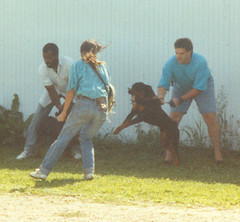
In 1989 I did this:

Here I am, with my arm in a sleeve successfully inducing an aggressive little Rottweiler to bite me.

What you don't see in this picture is how my knees are like water, my stomach is churning, my heart is pounding, and I am terrified.

By the time I had finished dog training school, I was no longer terrified of large aggressive dogs - and I never did protection training again.

This morning I uploaded a collection of my dog training school pictures at Flickr, go check them out. The quality of the photos isn't that great, but I think they are pretty interesting. I added explanatory captions and everything.

I am now amazingly inspired by ... me! Wow! How cool is that?


Related Posts with Thumbnails

Ask Auntie Moss

Auntie Moss

Ask any yes or no question, and Auntie Moss be givin' you an answer. This old witch woman is wiser than you think. Go ahead, give it a go.
Your question:
Auntie Moss says:

For A Different Kind Of Reading Try This!

Disclaimer

Images that appear on this site, original or modified for entertainment purposes, are copyright their respective owners and shirleytwofeathers claims no credit unless otherwise noted. If you believe your copyright has been infringed upon please contact me so I can start the removal process.